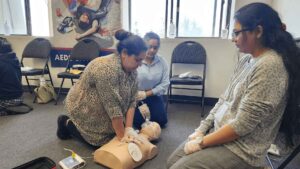

Facing a cardiac emergency in Canada requires immediate clinical intervention, not just a 911 call. Approximately 35,000 out-of-hospital cardiac arrests occur in Canada each year, with a national survival rate of only 10 percent without bystander action. When a trained bystander performs High-Performance CPR and deploys an AED within the first few minutes, survival rates can reach 70 percent. Canadian Red Cross CPR certification, compliant with WSIB Regulation 1101 and CSA Z1210:24, gives every Canadian the skills to close that gap.
Find a CPR and First Aid Course Near You
Canadian Red Cross certified courses at 30+ locations across Canada for individuals, families, and organizations.
35,000
out-of-hospital cardiac arrests per year in Canada, most occurring where no medical professional is present
70%
potential survival rate when trained bystander CPR and AED are applied within the first few minutes
10%
current national survival rate for out-of-hospital cardiac arrest without trained bystander intervention
Why Does Cardiac Emergency Response Training Matter More Than Ever in Canada?
A cardiac emergency is one of the most intense and time-critical medical situations a person can face. Whether it is a sudden cardiac arrest (SCA) where the heart’s electrical system malfunctions, or a massive heart attack where blood flow is physically blocked, the actions taken in the first three “Platinum Minutes” will determine the final outcome. Every second counts, and the difference between full neurological recovery and death often comes down to whether someone nearby has the first aid training to act decisively before paramedics arrive.
In Canada, approximately 35,000 cardiac arrests occur outside of hospital settings every year. The vast majority strike in private residences, corporate offices, crowded shopping centres, and public parks where medical professionals are not immediately present. When a cardiac arrest occurs, the victim collapses instantly, becomes unresponsive, and stops breathing normally. Without immediate intervention, irreversible brain damage begins within four to six minutes. It is crucial to act quickly, as victims can die within minutes without bystander intervention. The benefits of CPR certification are significant: it equips people of all ages with essential life-saving skills that can be applied across a wide range of emergency situations beyond cardiac arrest.
The national survival rate for out-of-hospital cardiac arrest currently hovers around a grim 10 percent. However, when a trained bystander initiates CPR and AED use immediately, survival rates can reach as high as 70 percent. At Coast2Coast First Aid & Aquatics, we specialize in closing this survival gap by equipping everyday Canadians with the clinical skills and psychological confidence to manage high-stakes emergencies.
What Is the Difference Between a Heart Attack and Sudden Cardiac Arrest?
One of the core pillars of the 2026 Canadian Red Cross curriculum is learning to distinguish between these two frequently confused emergencies. Providing the wrong response can waste precious seconds during the “Physiology of the Save.” Canadian Red Cross cardiac emergency protocols are aligned with current international resuscitation science, including standards set by the International Liaison Committee on Resuscitation (ILCOR), adapted for the Canadian healthcare context.
What Is a Heart Attack? (The Circulation Problem)
A heart attack occurs when a blocked artery prevents oxygen-rich blood from reaching a section of the heart muscle. The person is usually conscious and may experience crushing chest pain, pressure, or discomfort radiating to the arm, jaw, or back. Other symptoms include shortness of breath, nausea, and cold sweats. While a heart attack is a high-priority emergency, the person’s heart is still beating. Your role is to call 911, assist them into a comfortable position, and help with prescribed medications such as nitroglycerin or aspirin as permitted under CSA Z1210:24 standards.
What Is Sudden Cardiac Arrest? (The Electrical Problem)
Sudden Cardiac Arrest (SCA) is an electrical malfunction that causes the heart to quiver or stop pumping blood entirely. The victim collapses instantly, is totally unresponsive, and stops breathing or has agonal gasps. There is no pulse. Cardiac arrest can also result from events such as drowning or choking, making it critical to perform CPR immediately to maintain oxygen flow to the brain. This is the only scenario where High-Performance CPR and an AED are required immediately. For professionals such as security guards and daycare staff, rapid recognition of this difference is a mandatory certification prerequisite.
What Is the Out-of-Hospital Chain of Survival?
To maximize the chance of recovery, we follow a clinical protocol known as the Chain of Survival. As a bystander or workplace responder, you are responsible for the first three links:
- Early Recognition and 911 Activation: Identifying the collapse and calling for help immediately to engage the EMS system without delay.
- Early High-Performance CPR: Beginning chest compressions within the first 60 seconds to maintain hemodynamic pressure and oxygen flow to the brain and vital organs.
- Rapid Defibrillation: Locating and utilizing an AED as soon as it arrives on scene to reset the heart’s rhythm. Performing CPR and using an AED together can double the chances of survival for someone experiencing cardiac arrest.
In high-density urban environments, responders often face “Vertical Response Delay.” If a victim collapses on the 40th floor of a high-rise, it can take paramedics significantly longer to clear security and wait for elevators. In these scenarios, the trained bystander is the only real link in the chain until paramedics step off the elevator. First responders and trained individuals can dramatically increase survival rates, particularly in dense urban centres where every floor between the victim and the street adds critical minutes. Mastering these skills is essential for property managers and concierge staff who are often the first to arrive.
Watch: How to Perform High-Quality CPR
What Is High-Performance CPR and Why Does the CCF Metric Matter?
In 2026, we train students in High-Performance CPR, which prioritizes the Chest Compression Fraction (CCF). CCF is the percentage of total resuscitation time spent actively performing chest compressions. Resuscitation science proves that even brief pauses, whether to give breaths or check for a pulse, cause blood pressure to plummet, starving the brain and other vital organs of oxygen. If you are uncomfortable with mouth-to-mouth rescue breaths, focusing solely on continuous, high-quality chest compressions is still far better than doing nothing.
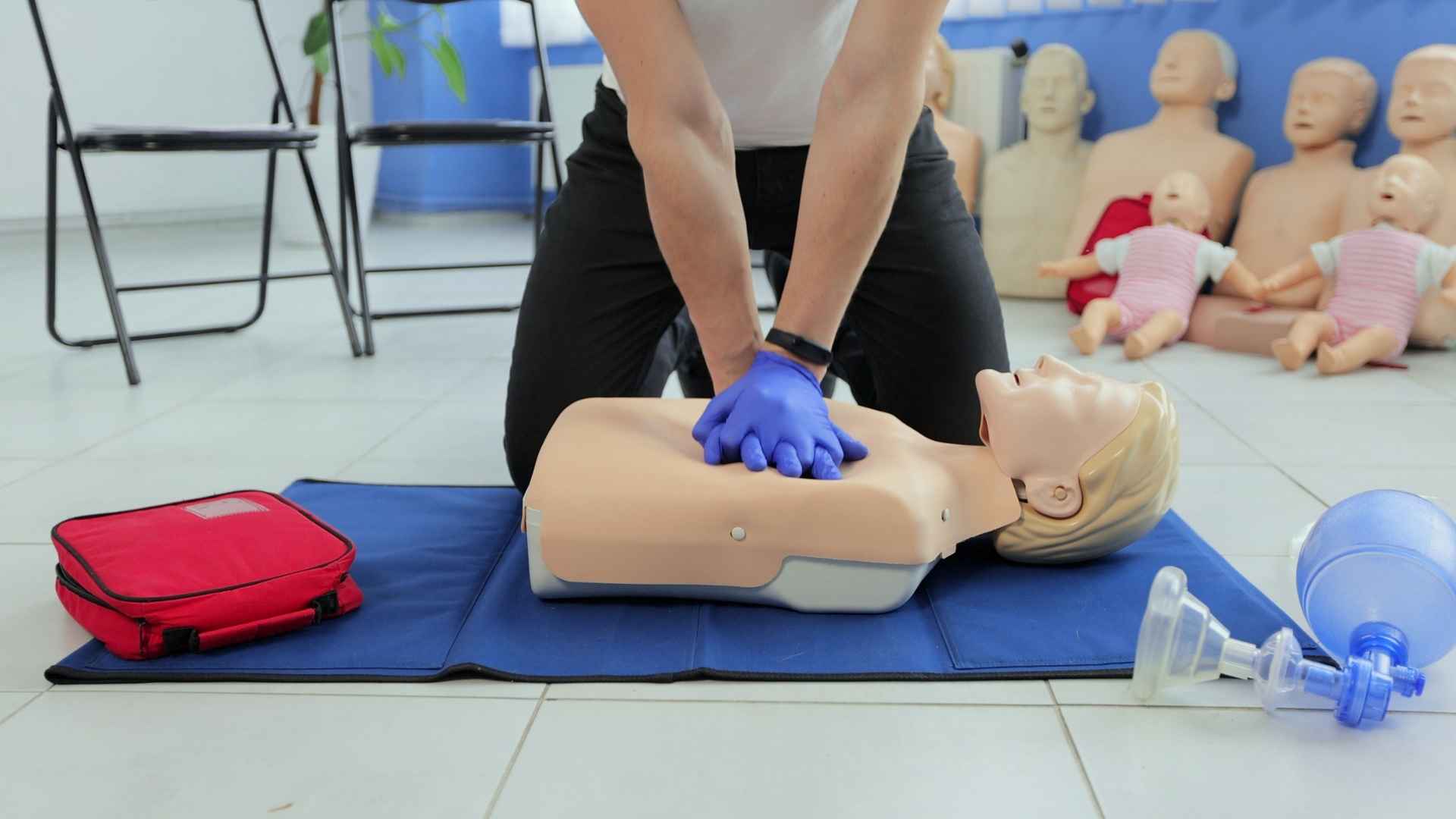
During your practical skills assessment, our instructors use high-fidelity manikins that provide real-time digital feedback on your technique. You must achieve a compression depth of at least 5 centimetres for adults at a rate of 100 to 120 compressions per minute. We also teach the critical importance of barrier devices such as one-way pocket masks, which allow rescuers to deliver rescue breaths safely while protecting themselves from infectious disease transmission.
Which Canadian Professionals Require CPR and First Aid Certification?
In Canada, many high-stakes professions have strict medical training mandates that must be renewed every three years to remain valid under WSIB Regulation 1101. First aid courses are offered in blended, instructor-led, and in-person formats, all designed to teach essential life-saving skills including CPR, AED use, wound care, and emergency scene management, in compliance with national standards for workplace safety:
- Security Guards and Loss Prevention: Personnel patrolling malls or transit hubs must maintain Intermediate / Standard First Aid to keep their provincial licences active and manage crowd-related medical emergencies.
- Daycare Staff and Teachers: Legally required to hold CPR Level C to manage pediatric emergencies like infant choking and anaphylaxis.
- Construction and Industrial Workers: High-risk environments demand leaders trained in severe bleeding control and oxygen administration.
- Healthcare Providers: Nurses, dental staff, and clinical workers require Basic Life Support (BLS) to master team-based resuscitation dynamics and advanced airway management.
- Hospitality and Fitness: Restaurant managers and personal trainers are the first line of response for cardiac events in public venues.
What Are the Mandatory Workplace Compliance Requirements for Cardiac Emergency Preparedness?
For Canadian business owners, ensuring staff are prepared for a cardiac emergency is a strict legal requirement. Failure to meet CSA standards for first aid coverage can result in severe Ministry of Labour fines and significant corporate liability. AEDs are increasingly available in public spaces including airports, shopping centres, and schools, but they are only effective if someone on-site has the training and certification prerequisites to use them confidently.
Coast2Coast helps businesses meet these standards through private group training sessions. Our instructors bring all necessary equipment, including AED trainers and high-fidelity manikins, directly to your corporate facility or warehouse. This site-specific training allows your team to practice navigating their actual work environment while managing a simulated victim, which is far more effective than off-site classroom training.
Get Your CPR and AED Certification Today
Hands-on High-Performance CPR and AED training for individuals, families, and workplace teams.
What Flexible Training Formats Are Available for CPR Certification in Canada?
Coast2Coast understands that Canadians lead demanding lives. To maximize accessibility, we offer a highly popular blended online learning format. This allows employees to complete the medical theory at their own pace from home. Once the online modules are finished, you attend a shortened, fast-track in-person session focused entirely on your hands-on practical skills assessment and written examination. Online first aid courses are increasingly popular in Canada due to their flexibility, but the mandatory in-person component is never waived because physical competency in CPR cannot be assessed remotely.
If your current three-year certificate is nearing its expiry date, our streamlined recertification courses offer a rapid review of the latest 2026 protocols, ensuring you remain legally compliant and clinically ready without retaking the full program.
Bring Cardiac Emergency Training to Your Workplace
Site-specific private group CPR and AED training with all equipment provided at your facility.
Key Takeaway
With 35,000 Canadians experiencing cardiac arrest outside of hospital each year and a national survival rate of just 10 percent, the gap between who survives and who does not comes down to one factor: whether a trained bystander was present. High-Performance CPR, prompt AED deployment, and the clinical confidence to act without hesitation are skills that can only be built through hands-on Canadian Red Cross training. Every Canadian within earshot of a cardiac arrest is that person’s best chance at survival.
Get Intermediate / Standard First Aid and CPR Certified Today
Two-day Canadian Red Cross Intermediate / Standard First Aid satisfying CSA Z1210:24 and WSIB requirements across Canada.
Frequently Asked Questions: Cardiac Emergency Response and CPR in Canada 2026
More FAQs: Security Guards, First Aid Kits, Written Exams, Barrier Devices, Expired Certificates, and Certificates
Sources and Further Reading
- Heart and Stroke Foundation of Canada: Out-of-Hospital Cardiac Arrest Statistics (2024)
- Canadian Red Cross: CPR and AED Course Guidelines, 2025 Curriculum Edition
- CSA Group: CAN/CSA-Z1210:24 First Aid in the Workplace (National Standard of Canada)
- WSIB Ontario: Regulation 1101, First Aid Requirements (O. Reg. 1101)