

CPR training in Toronto is critical because cardiac arrest strikes without warning, brain damage begins within four to six minutes, and Vertical Response Delay in high-rise buildings can push EMS arrival times well beyond that window. WSIB Regulation 1101 and CSA Z1210:24 also legally require Ontario employers to maintain certified first aiders on every shift, making current certification both a lifesaving skill and a workplace compliance obligation.
How to Prepare for Medical Emergencies in Toronto
In a city as exceptionally large and dynamic as Toronto, sudden medical emergencies are an everyday reality. With nearly three million residents in the city proper and millions more commuting across the Greater Toronto Area, the statistical probability that you will witness or encounter a life-threatening emergency at some point is significant. Whether you are navigating the crowded platforms of the TTC subway, working in a bustling Financial District high-rise, or attending a community event, comprehensive first aid training equips you with the clinical knowledge and physical skills to act decisively in those critical moments.
The decision to get CPR certified is not just a personal investment in your own preparedness. It is a contribution to the safety of your entire community. Every new person trained expands the vital network of potential lifesavers across Toronto’s diverse neighbourhoods. When more people are formally trained to step in, bystander response times improve, survival rates increase, and lives are saved. All participants receive official Canadian Red Cross certificates upon successful completion, providing recognized proof of competency for employment and compliance requirements.
The Reality of Cardiac Emergencies and Vertical Response Delay in Toronto
Cardiac arrest remains one of the leading causes of death in Canada, and Toronto is no exception. Each year, thousands of people in the GTA experience sudden cardiac arrest outside of a hospital setting. CPR training prepares individuals to respond to cardiac arrest and other life-threatening cardiovascular emergencies. When the heart stops, its electrical system malfunctions and vital blood flow to the brain is cut off. Without immediate physical intervention, irreversible brain damage begins within four to six minutes.
While Toronto Paramedic Services are world-class, even the fastest ambulance cannot bypass the physical reality of urban density. During peak hours on the Gardiner Expressway, the Don Valley Parkway, or heavily congested downtown streets, every minute of transit delay is fatal. Emergencies in Toronto frequently occur in towering condominium buildings and corporate towers, a logistical challenge known to paramedics as Vertical Response Delay. Navigating security desks, waiting for elevators, and hauling heavy medical gear can mean EMS takes 10 to 15 minutes to reach a patient on the 40th floor.
This is why immediate bystander CPR is non-negotiable. When a trained colleague or neighbour initiates chest compressions during those Platinum Minutes, they act as a manual pump, keeping oxygenated blood flowing to the victim’s brain until paramedics step off the elevator. Specialized Basic Life Support (BLS) courses are also available for healthcare providers and first responders seeking advanced emergency response skills.
The Science of Survival: High-Performance CPR and Chest Compression Fraction
Effective resuscitation is not just about watching a theory video. It requires rigorous technique, clinical precision, and the ability to stay focused under extreme psychological pressure. Modern 2026 Canadian Red Cross training emphasizes High-Performance CPR, a methodology scientifically designed to maximize the patient’s chance of survival.
During the practical skills assessment, Coast2Coast instructors focus heavily on Chest Compression Fraction (CCF), the total percentage of rescue time during which active compressions are being performed. Minimizing pauses during rescuer switches or AED pad application is critical to maintaining the hemodynamic pressure needed to keep the brain alive. AED use is a core part of the curriculum, and participants receive hands-on instruction to ensure confidence and effectiveness in real emergencies.
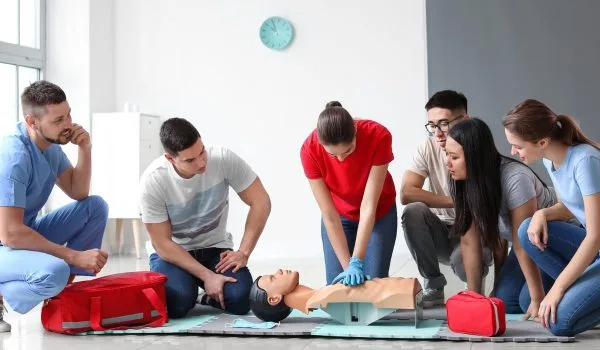
You will train on professional-grade, high-fidelity manikins that provide real-time digital feedback on compression depth (at least two inches for adults) and rate (100 to 120 beats per minute). Successful course completion requires a minimum grade of 75 percent on the written evaluation and a full demonstration of required skills during the hands-on assessment.
Workplace Compliance in Toronto: WSIB Regulation 1101 and CSA Z1210:24
For employers across Toronto, keeping staff trained is not just an ethical duty. It is a strict provincial law. The Workplace Safety and Insurance Board (WSIB) actively enforces Regulation 1101, which mandates the exact number of certified first aiders required on every shift based on workforce size and industry risk classification. First aid training in Toronto must be WSIB-approved and comply with Ontario workplace safety requirements to satisfy these standards.
To align with CSA Z1210:24, workplaces must ensure their designated responders pass a comprehensive written examination and practical skills test. The WSIB is expected to update its first aid program requirements in 2026 to fully align with the CSA Z1210:24 standard. Failure to maintain adequate coverage can result in Ministry of Labour fines and significant corporate liability if an employee is injured on-site.
Coast2Coast simplifies compliance for Toronto businesses by offering private group training, bringing certified instructors and high-fidelity equipment directly to your corporate office or manufacturing floor. Organizations should also monitor certificate expiration dates closely: letting certifications lapse requires full course re-enrollment rather than a shorter recertification.
Find a CPR Course at a Toronto Location Near You
Multiple locations across the GTA. Weekday and weekend scheduling. Hands-on training with certified instructors.
Who Needs CPR Certification in Toronto: Industry Requirements
Holding a valid, current Canadian Red Cross certificate is a significant advantage in Toronto’s competitive job market. Many roles carry strict certification prerequisites that must be maintained without lapse.
Security Guards and Loss Prevention: Personnel patrolling the PATH network, Scotiabank Arena, or Financial District towers must hold Intermediate / Standard First Aid and CPR Level C to maintain their provincial security license. These workers are routinely the first to respond to cardiac and trauma emergencies in high-traffic public spaces.
Construction Foremen and Site Supervisors: High-risk job sites across the GTA demand leaders trained in severe bleeding control, tourniquet application, and spinal injury immobilization. Emergency First Aid and CPR Level C is typically the minimum standard under CSA Z1210:24 for construction environments.
Daycare Staff and Early Childhood Educators: Ontario-licensed childcare settings require staff to hold CPR Level C, covering resuscitation for adults, children, and infants. Training addresses pediatric emergencies including anaphylaxis and infant choking.
Hospitality, Event, and Non-Aquatic Staff: Event planners, hotel managers, and fitness facility staff must be prepared to respond to sudden cardiac events in crowded public venues where EMS response times are uncertain.
Healthcare Professionals: Toronto nurses, dental hygienists, and clinic staff require Basic Life Support certification rather than standard CPR. BLS covers advanced team-based resuscitation, bag-valve-mask ventilation, oxygen administration, high-performance CPR, opioid overdose response, and trauma management. BLS certification is required annually in most hospital and emergency service settings. The CPR HCP designation was formally upgraded to the BLS standard in April 2019.
Flexible Training Formats for Busy Torontonians
Coast2Coast understands that Toronto residents lead demanding lives. CPR and first aid certification is available in a blended online learning format that allows you to complete the theory modules at home at your own pace, then attend a significantly shorter in-person session focused entirely on the hands-on evaluation and written examination. This hybrid model reduces total in-class time without compromising the credential.
If your current certificate is approaching its three-year expiry, recertification courses offer a condensed review of the latest 2026 protocols so you remain compliant without retaking the full program. Note: recertification for Intermediate / Standard First Aid can only be completed once. If your certificate has been expired for more than three years, the full course is required to regain certification.
Train Your Entire Toronto Team On-Site
We bring instructors, manikins, and AED trainers directly to your office or workplace. Custom scenarios for your industry.
Key Takeaway
In Toronto, the gap between cardiac arrest and professional help is measured in minutes that most EMS responses cannot close. Vertical Response Delay in high-rises, peak-hour traffic on major corridors, and the documented hesitation of the Bystander Effect combine to make trained bystanders the most critical link in the chain of survival. CPR certification through a WSIB-approved Canadian Red Cross course is how you close that gap, for your family, your colleagues, and the stranger on the 40th floor.
Enroll Today
Join 150,000+ Canadians Who Are CPR Certified
WSIB-approved. Canadian Red Cross certified. Flexible scheduling across Toronto and the GTA.
Frequently Asked Questions: CPR Training Toronto 2026
More FAQs: Workplace Compliance, BLS, and Certification in Toronto
Sources and Further Reading
- Workplace Safety and Insurance Board (WSIB): First Aid Requirements, Regulation 1101
- CSA Group: CSA Z1210:24 First Aid Training for Workplaces (2024)
- Canadian Red Cross: CPR and AED Certification Standards (2026)
- Toronto Paramedic Services: Emergency Response Statistics
- Heart and Stroke Foundation of Canada: Out-of-Hospital Cardiac Arrest Data